Why More of a Fragrance Ingredient Doesn’t Always Mean a Stronger Scent
Why a little of one ingredient can stand out while a lot of another goes unnoticed, explained simply from a peer-reviewed science paper.
Published 10 November 2026

Here is something that surprises most people: the ingredient a perfume holds the most of is not always the one you notice. A tiny amount of one material can shape the whole scent, while a large amount of another stays in the background.
To see why, it helps to keep three things apart: how much of an ingredient is in the liquid, how much of it gets into the air, and whether your nose picks it up. They are linked, but they are not the same thing. This guide walks through each one, using a peer-reviewed scientific review as its source. [1]
The short version
- The amount in the bottle is not the amount in the air. Some ingredients escape into the air far more easily than others.
- Getting into the air is not the same as being noticed. Every material has its own detection threshold, and some are noticed at tiny amounts.
- Being noticed is not the same as smelling strong. How strong a scent feels is a separate question again.
Start with the liquid, not the note list
A perfume is a mix of scent ingredients dissolved in a carrier, usually alcohol. The alcohol can make up much of the bottle, and it has a smell of its own. But even among the scent ingredients, the one there is most of is not automatically the one you notice.
There are two ways to say how much. You can weigh each ingredient, which scientists call the mass fraction. Or you can count its molecules, which they call the mole fraction. Some molecules are heavy and some are light, so the same weight of two ingredients can hold very different numbers of molecules.
That matters, because the science of what rises into the air works by counting molecules, not by weight, so a percentage by weight can’t simply be used in its place. And a note list, such as vanilla, tobacco or woods, describes how a perfume smells. It is not a recipe with amounts.
wi = mi / mtotal
xi = ni / ntotal
- i
- One chemical ingredient in the mixture.
- wi
- Mass fraction: the ingredient’s mass divided by the total mass of the mixture.
- xi
- Mole fraction: its amount in moles divided by the total amount in moles. A way of counting molecules rather than weighing them.
- m, n
- Mass, and amount in moles. Molecules differ in molar mass, so equal mass fractions need not mean equal mole fractions.
Weigh them, then count them
The same weight of each ingredient. The scale balances.
Now count the molecules: the lighter one has three times as many in the same weight.
Two imaginary ingredients, one with heavy molecules and one with light ones. An illustration, not measured data.
The air above a perfume has a mix of its own
The thin layer of air just above a liquid is called the headspace. Molecules keep escaping from the liquid into that air, and some drop back in. When as many leave as return, the two sides are in balance. Scientists call this equilibrium: the molecules are still moving, but the overall amounts stop changing.
Here is the key idea. The mix in that air is not a copy of the mix in the liquid. Some ingredients escape into the air far more easily than others, and the ingredients around them can help them out or hold them back. So what you smell above a perfume is not its recipe in the same proportions. [1]
That balance is an ideal case. Perfume on your skin sits in moving air, so it is rarely in perfect balance. Keep that in mind whenever a lab calculation is used to describe how a perfume wears.
The animation below follows one spray on the wrist, using three imaginary materials, and keeps the three steps apart:
- On the skin: the liquid film, and how much of each material it holds.
- In the air just above: molecules leave the film and return until the exchange balances, leaving a mix of its own.
- At the nose: each material measured against its own detection threshold, not against the others.
- On the skin The film left by one spray holds plenty of material A, some B and only a trace of C.
- In the air just above Molecules leave the film and return. Once the exchange balances, the air holds a different mix: C makes up far more of the air than of the liquid.
- At the nose Each material in the air is compared with its own detection threshold. C clears its low threshold. A, though plentiful, stays under its high one.
A conceptual illustration of the ideas in the review, drawn with three imaginary materials. It is not measured skin data, and not a Kassira formula. The air above the skin is drawn as if it settles into perfect balance, which is a lab ideal. Moving air changes what reaches a nose, and this drawing doesn’t work that out.
What decides how much gets into the air
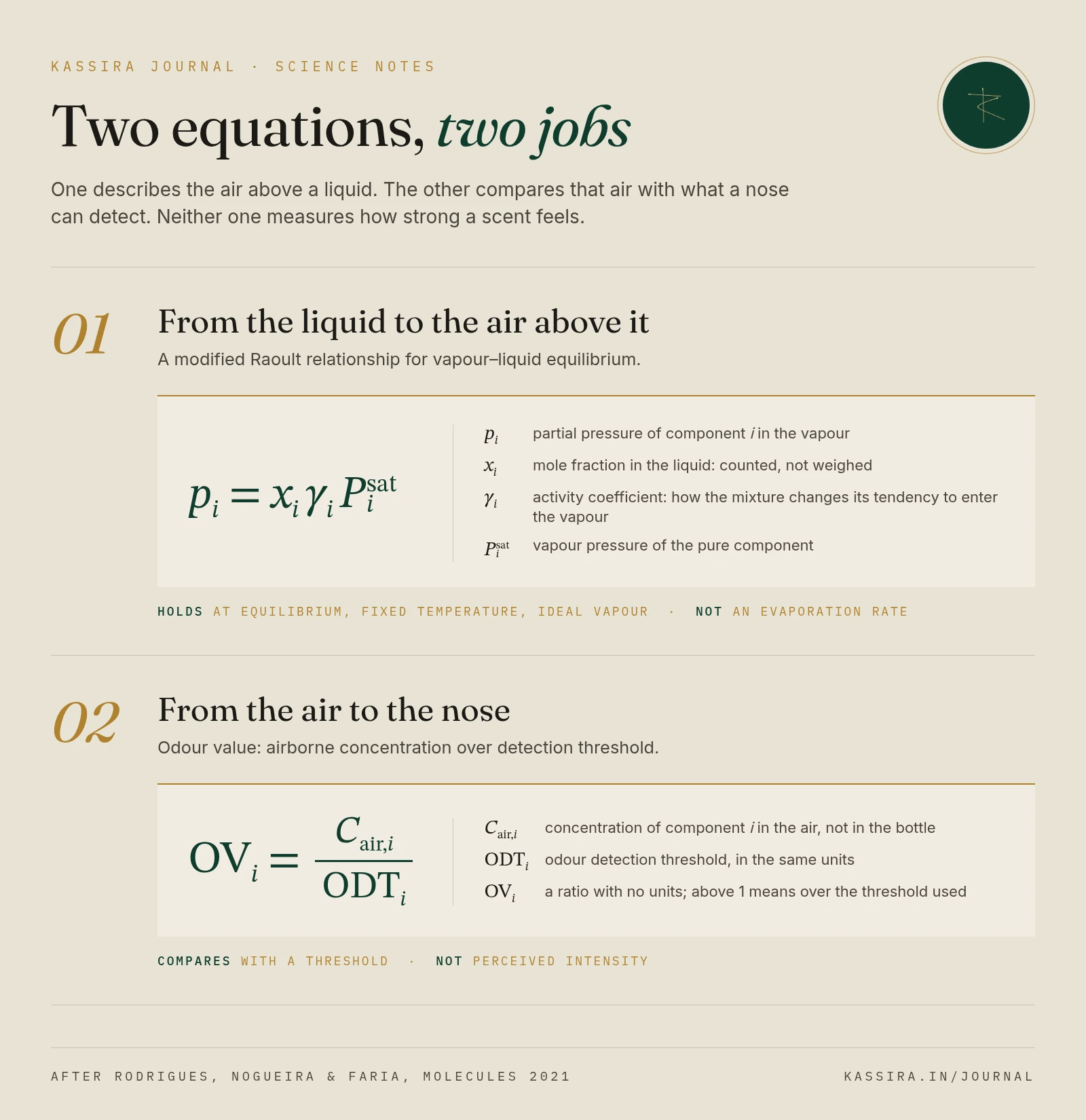
The review describes this with a well-known chemistry equation, a modified form of Raoult’s law. You don’t need the maths. It says that, at a fixed temperature, the amount of an ingredient in the air above a liquid depends on three things multiplied together: [1]
- How much of it is in the liquid, counted in molecules.
- How easily it escapes on its own. This is its vapour pressure: some materials escape readily, others much less so.
- How the rest of the mix treats it. Some mixtures hold an ingredient back, others push it out. Chemists call this the activity coefficient.
So the amount in the liquid is only one of three factors. An ingredient with fewer molecules in the liquid can still put more into the air than another, if it escapes more easily or the mix pushes it out. How heavy a molecule is does not settle the question on its own.
One fair point the other way: for a single ingredient, if everything else stays the same, adding more of it does put more of it into the air. The equation doesn’t say amounts don’t matter. It says you can’t compare two different ingredients, or predict a whole scent, from amounts alone. And changing a recipe can change how the mix treats each ingredient.
pi = xi × γi × Pisat
- pi
- Partial pressure: the ingredient’s contribution to the pressure of the air mixture above the liquid.
- xi
- Its mole fraction in the liquid.
- γi
- Activity coefficient, said “gamma”: how the rest of the mix holds the ingredient back or pushes it out. It has no units, and 1 means ideal mixing.
- Pisat
- Saturation vapour pressure of the pure ingredient at that temperature: how readily it escapes on its own. Both pressures use the same units, such as pascals.
This form treats the air as an ideal gas and lets the liquid mix non-ideally. It describes the balance at a fixed temperature, not how fast a film evaporates. [1]
Three things set how much rises into the air
How much is in the liquid
How easily it escapes
How the mix treats it
Plenty in the liquid, slow to escape
A trace, quick to escape
Amount in the air
Turn the dials. The three are multiplied together, so no single one decides the answer: a trace that escapes readily can beat plenty that hardly escapes. An illustration, not measured data.
Getting into the air is not the same as being smelled
A molecule in the air still has to be noticed. Every material has an odour detection threshold: the smallest amount in the air at which people can detect it, in a set test. Detecting a smell is not the same as recognising it. You can notice something before you can say what it is. [1]
Thresholds differ hugely from one material to another. So a small amount of one material in the air can be easier to notice than a large amount of another. Threshold figures also depend on how they were measured and who was tested. They are not one fixed line for every nose.
The review compares the two with a simple ratio called the odour value: the amount of a material in the air, divided by its detection threshold. Above 1 means it is over the threshold used; below 1 means it is under. [1]
These are two different kinds of idea. The balance equation above is physics: how much of an ingredient sits in the air above a liquid. The odour value is about people: whether that amount is above what noses could detect in a test. One can’t stand in for the other, and neither tells you how strong a scent feels.
An odour value is not a measure of how strong a smell feels. A value twice as high does not mean a smell twice as strong. How intense something seems is a separate question, and the review treats it separately. [1]
OVi = Cair,i / ODTi
- OVi
- Odour value. It has no units: above 1 means over the threshold used, below 1 means under.
- Cair,i
- Concentration of the ingredient in the air being considered, not in the bottle.
- ODTi
- Its odour detection threshold in air, from a stated test method. It uses the same units as the concentration, for example milligrams per cubic metre.
A partial pressure from the balance equation can’t be dropped in as a concentration without converting it first. [1]
Raise the amount in the air
Amount of each material in the air
Material A: high detection threshold
Material C: low detection threshold
Both materials get the same amount in the air. Each is judged against its own threshold, so C is noticed first. Being over a threshold means it can be detected, not that it smells strong. An illustration, not measured data.
A real example from the research
One study in the review looked at a marjoram extract (Origanum majorana) mixed into different bases, including dipropylene glycol, a common perfume carrier. The researchers sampled the air above each mix and measured what was in it with lab instruments. [1]
In the dipropylene glycol mix, a material called myrcene was measured in smaller amounts in the air than the other scent materials. Yet the review gives it a part in the smell, because people can detect it at very low levels. There was less of it, but it was easier to notice.
That conclusion comes from air measurements read alongside threshold data. It is not a wearing test on people, it does not prove what every person smells, and it says nothing about any Kassira formula.

Why no model is the whole perfume
To predict which smell will lead in a mix, the review describes a simple shortcut: pick the material with the highest odour value or modelled intensity. Together with the air calculations, this can map which material leads in simple mixtures. [1]
It is a useful shortcut, not a rule that you smell one molecule while the rest disappear. It can’t capture the full blended character of a perfume, or the differences between one person and the next. The review also names two more limits: some molecules come in mirror-image forms that can smell different, and some materials change character as their amount changes. [1]
What these equations can’t tell you about wearing perfume
The animation stops at the nose on purpose. The first equation describes the balance between a liquid and the air right beside it, in set conditions. The odour value compares the amount in that air with a detection threshold. Neither one, on its own, tells you:
- How fast perfume evaporates from your skin.
- How a scent travels through a room or reaches someone near you.
- How the scent changes over time as its mix changes.
- How strong it feels to any one person.
Those questions depend on the air moving around you, the way scent spreads, and your skin itself. The review covers spreading and skin separately. [1]
The same goes for a strength figure printed on a label. It describes the liquid as a whole. It is not the amount of one ingredient, not a measurement of the air, and not how strong the scent feels.

Read the notes as character, not chemistry
A recipe tells you what is in the liquid. An air measurement tells you what was in a sample of air. A smell test tells you what people noticed in set conditions. None of them can stand in for the others.
So the notes for Formula N°17 Ember & Leaf and the Gourmand cabinet are a guide to how a scent smells, not a list of chemical amounts. They don’t give the numbers you would need to work out an odour value.
Six of our flagship formulas, one from each cabinet:
- Formula N°02 Sicilian Sugar
- Formula N°06 Nomad's Oud
- Formula N°09 Mint Vanille
- Formula N°12 Glacier Salt
- Formula N°14 Caramel Ash
- Formula N°17 Ember & Leaf
Research basis
[1] Rodrigues, Alírio E.; Nogueira, Idelfonso; Faria, Rui P. V. “Perfume and Flavor Engineering: A Chemical Engineering Perspective.” Molecules, 26(11), 3095, published 22 May 2021. DOI: 10.3390/molecules26113095. A peer-reviewed, open-access narrative review of engineering methods, not a study of Kassira products.
Not sure which one is yours?
Tell Kassira AI what you love, what you can't stand, where you'll wear it and your city, and it picks Your Three from the Formulary.
If you'd like a seat at the table, Batch 001 of the Seventh Cabinet, our launch membership, has 150 seats: ₹1,199 a bottle with shipping included, one of each formula, and members tell us what we make next.
Questions
Does adding more of an ingredient always put more of it in the air?
For the same ingredient, with everything else unchanged, yes: more in the liquid means more in the air. But changing a recipe can change how the mix holds each ingredient, and more in the air still doesn’t tell you how strong it will smell.
Can a note list tell me which ingredient I’ll smell most?
No. Notes describe how a perfume smells, not the amounts in it. Working out an odour value needs the amount of a material in the air and its detection threshold, and a note list gives neither.
If an odour value is above 1, will everyone smell it?
Not necessarily. It means the amount is above the threshold used in that calculation, but thresholds depend on how they were measured and on the people tested. It also says nothing about the full smell of a mix.
Is the air just above a perfume the same as what reaches someone nearby?
Not necessarily. Air in perfect balance with a perfume is a lab idea. What reaches another person also depends on how the scent spreads and how the air moves. A calculation of the first can’t tell you the second.
If a material is easy to smell, does it evaporate easily?
No. How easily you can detect a material and how easily it escapes into the air are separate properties. Both matter for what you end up noticing.